Utica
Memory is a coward

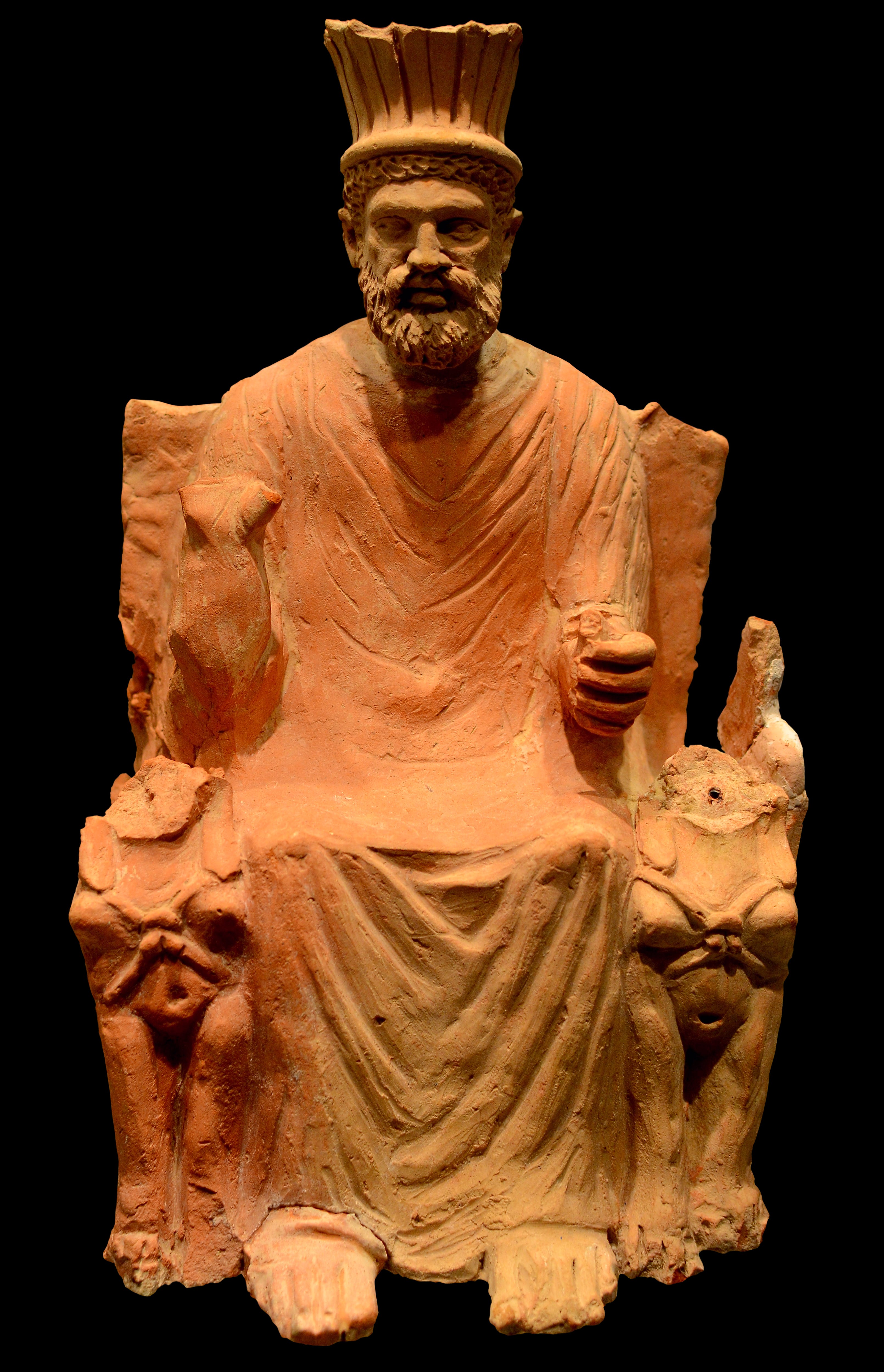
Statue of Baʿal Hammon
Author’s Note
Utica is a chapter from my historical novel Carthago Delenda Est, set during the opening stages of the Third Punic War in 149 BCE.
The chapter follows Ainon, a Roman Optio, as Roman forces occupy the North African city of Utica before the final siege of Carthage.
Content warning: this chapter contains depictions of violence and ritual sacrifice.
Utica
Memory is a coward, always retreating, sure-footed one moment, faltering the next.
History is the mirage it flees toward, shimmering on the horizon of a desert we cross but never conquer. Unreal, shifting, slipping away the closer we come.
We reach, but never hold. The past may be recalled, never lived again.
We chase what we once held dear, but grasp only ghosts. We thirst for true waters, but find only the dust of recollection.
In our remembrance we change the past and in doing so it changes us. We were never the same, always different, always strangers to ourselves.
Much time has passed. Who can say how much? Do even the gods know?
I met a man in Syracuse who sold spices, his skin creaked like dark tanned leather, his greying ginger beard smelt of crushed pepper. He told me stories from the village where he was born. That the gods were born and died just like us. That they too are reborn. That we are all bound to the same wheel turning round and round.
If that is true, perhaps no one knows the age of the mountains or the bones at the bottom of the sea.
When I said we should smash the wheel, he did not speak for a long time. He inhaled smoke from his long wooden pipe, two fingers curling through his beard, then laughed.
“So what are you buying today, Romaka? Something for weary legs, yes?”
As I walk to Utica I know I am fortunate that I have yet to feel the bite of time, sharp as Cerberus’s teeth. I remain as able and fit as any man half my age: I eat simply, toil ceaselessly, sleep on camp beds covered with coarse goat skins, and bear shield and armour across the long miles we march.
Many who fought alongside me in Sardinia, Greece, and Hispania have joined this campaign. Our last campaign. They look older. They have changed. They speak now of families and villas, businesses and farms. I have not changed. I am still the same man I was when I first joined the legion. They have much to lose. I have nothing.
Rome’s armies, like rivers at snowmelt, are swollen with mighty veterans from many wars, many vengeances thawing. We are formidable. Few could confront a force so experienced and well supplied. Tiberius Sempronius Gracchus, our commander in Sardinia, is also here with us. I’ll be glad to see him again, if only from a distance, surrounded as ever by his bodyguards and standard bearers.
This is not the army Hannibal once faced in the Second Punic War. It has been transfigured.
The more I experience, the harder it becomes to remain in the present; recollections weigh on me like a burden I cannot set down, only collect. I clench my fist, willing myself to row back from the tide of memory and return to the shores of Utica.
The Berbers and Phoenicians once called this place the “Ancient of Days.” It is the elder sibling of Carthage, older even than Rome, another Phoenician settlement before Carthage became more than its forebears had ever conceived.
Once independent, it allied itself with Carthage long ago, but the bond between them had weakened with the passing years.
That morning, its elders saw our fleet, hundreds of ships flying the red banners and eagles of Rome, stretching across the sea. They knew resistance meant graves and a burning city. The days of the Punic people were finished. Those loyal to Carthage fled; those willing to gamble on Roman mercy remained. As order departs a city, chaos enters in its wake, I walk its streets.
At dawn, we are told to take care, we will need the citizens for our baggage trains and auxiliaries, as scouts and support staff for our armies. A little rough play, a little looting, but this is not Carthage. Go easy boys, Scipio said. Go easy.
I stand now at the docks and witness legion upon legion descending upon Utica from the sea, our silhouettes stark against a blood-red dawn. Centurions clad in crimson cloaks leap off the bows of ships, leading us as we push into her harbors. We speak of a siege that will bleed the land for five long years, ten if needed.
We will construct vast siege engines from the iron nails and timber of their own homes. Their roads will groan under the weight, wheels turning with the certainty of destruction. We have come.
Utica was Scipio Africanus’ battleground over fifty years ago. He landed here with thirty thousand men. Now our troops retrace the steps of their fathers and grandfathers, stepping from triremes onto the same shores, like a muscle’s memory. A great and fearful migration of Romans, like blood-streaked starlings sweeping in from across the seas. We gather.
I see that battle as clearly as I see the flies crawling on my hand this day. At Utica, Carthage stood beside their Numidian allies beneath the dread hand of Hannibal Barca, the man who had shattered four of our armies and turned northern Italy into a graveyard.
Their numbers matched ours, warrior for warrior. Scipio, not yet honoured with the title Africanus, vulpine in his cunning, negotiated a truce when night fell, then sent outriders to scout the enemy encampment.
Discovering the Numidians had built their barracks from sun-dried reeds, tinder awaiting a spark, he ended the peace talks. Rather than let his men rest, he told them to go to bed but remain awake. He ordered troops cloaked in black to infiltrate the enemy lines and set their barracks ablaze with incendiary.
They had procured the Greek art of fire from those who envied Carthage: thick pine resin that clung to whatever it smothered, sulfur to feed the blaze, then quick lime to awaken the flames.
As the first flames clawed into the night sky, the signal was given. Our youngest and least armoured troops, the Hastati, sprinted into the camp from every direction under cover of darkness. They waited beside the burning buildings, killing those who fled. They barred doors, sealing the terrified inhabitants inside to choke on heat and smoke.
Some tried to escape by leaping through windows, tearing down walls, even ripping the roofs from their homes. Many were set alight themselves, crawling through burning resin and quicklime, screaming for the sea. They fell in smoking ruin far from the indifferent waves that continued to lap the shore.
For hours the waves came and went, indifferent, while noxious sulfur fumes and thick plumes of smoke swallowed the moon.
Hannibal woke to a fireball rising on the horizon. He rushed to aid his allies, never imagining we would break the peace so soon after parley. They believed it an accident. The Romans had learned by then that nothing is accidental in a disaster.
Hannibal still believed war was city against city, fought for land, honour, or titles. He was blind to the lesson he had taught us. He had broken our armies at Cannae and Trebia. We were broken, but he never landed the killing blow. He had failed as a hunter.
We returned stronger, harder, transformed by fire and struggle. It was as though we had been given new eyes, eyes that saw through the mist of generations of tears, burned clear in an instant by the glow of those barracks blazing against the desert night.
The old rules of war no longer applied. There were none. Anyone who believed otherwise was weak, foolish, and deserved slaughter.
In Hannibal’s bountiful harvest of victories, he had sown the seeds of his own undoing. He had destroyed our armies but made warriors of an entire people. He had cut down legions at Trasimene, our bodies crushed and drowning in the lake, yet gave rise to something new and terrible to behold: a people driven to unrelenting war by the fear of their own destruction.
The Romans.
From the age of fourteen, all I knew was war. No honour shone brighter than leading or winning in battle; no act or achievement earned praise unless it fed our wars.
We took Athenian ingenuity and invention and turned it toward war, the arc of a ballista’s spring, the density of a warship’s ram. We took Spartan discipline and shaped it into something far more potent. We cast aside the single hero, citizen brigades, tyrants bullying Helots, and replaced them with finely drilled legions of murderers.
We wore bright colours and sang as we marched, as do the finest killers. The ferocity of the Celts, the ingenuity of the Carthaginians, all forged in the fire of our suffering into something stronger. Something that knew no mercy. Unleashed unto the world.
Woe to the Carthaginians. Scipio’s cavalry and shock troops raised their swords, poised to strike as the enemy rushed through the night clutching buckets and pots of water to quench the blaze. Thousands fell before they understood what was happening, but how they screamed. Panicked shouts rang through the darkness as men fell and fled in every direction.
Hannibal escaped with four thousand troops; the rest were killed, sold into slavery, or kept by Scipio as guides, hostages, and informants.
Carthage reeled from the slaughter just as we once had, but they did not understand that war had changed the men who fought it. A year later they raised another army, and we broke that one too at the battle of the Great Plains. Two years after that, we met them at Zama.
And there, everything ended.
I am tired and thirsty, having left the boats two hours ago to wander the city. I need to rejoin my Contubernium before nightfall. I am an Optio, second to the Centurion of our Maniple. These men follow my command. I choose their way.
Utica swarms with desperate merchants hawking goods in thick, Punic-accented Latin. They sound like old men clearing their throats, debasing our words. Residents peer from narrow windows in mud-brick buildings, silent as stones. Occasionally a baby cries and is hastily hushed; somewhere in the old city, a cat screeches.
Flies swirl everywhere, more varieties than I ever knew existed. Some are large and angry enough to bite; others small as seeds, buzzing incessantly as they cover fruit and meat in thick, twitching layers. They swarm your face if you do not keep swatting.
City of flies.
Many of Utica’s citizens slump in doorways, too weak to stand, bellies bloated with hunger, letting the flies crawl across their glistening sweat. They were starving long before we arrived.
I wonder if Carthage emptied every nearby storehouse to provision itself for siege, leaving these people with nothing. It is hard to expect anyone to die for those who offer them no mercy. Then I think: what will we offer them?
War’s first victims always seem to be the ones the army claims to protect. Sardinia then, Utica now. It never changes. Famine and pestilence remain the foremost weapons in any arsenal.
The sun is merciless, so I stay beneath the market stall awnings. Already, young men prowl in gangs like jackals, looting freely now that the rule of law has collapsed and Carthage’s loyalists have fled. Our scouts ride out, we are securing the city, by morning, these looters will be dead or wearing our colours.
On a backstreet, I find a woman lying face down, her blue robe pulled over her head. Three steps away, a young man, perhaps her son, lies in a pool of blood.
One, two, three.
I count the steps. For a moment I feel the flicker of a fly against my forehead, the image of something stirring in my mind too quickly to recognise its form. I feel something else too. I swipe the fly from my face and let the feeling slip away. I leave them where they fell.
My mouth is parched; my tongue sticks to my gums. Tomorrow will be a long day. I am outside the city now. I kneel beside a dusty roadside and drop my pack, leather straps sliding from my shoulders. A cooking pot rattles against the stones. From my goatskin pouch I gulp watered-down wine, its coarse hairs scratching my palms sticky with old sweat. It tastes bitter, of old grapes and vinegar, laced with the grit of a thousand marching feet.
I close my eyes against the glare, remembering how fresh wine once tasted on a villa’s patio, in the warm evening light dancing across mosaics dedicated to the Muses, fountains tinkling, women laughing. That life feels a thousand miles away. It may as well be forgotten for now; the remembrance of comfort brings only pain.
As I move to pick up my pack, my toe strikes a battered granite stone, two or three feet tall, toppled in the dust. Heavy. Ancient. I lean down to inspect it, revealing a crude carving: a large triangle with a circle resting upon its peak, joined by a single horizontal line.
It reminds me of how a child might draw a mother, a triangle for the body, a circle for the head, two thin arms. My friend Varro’s daughter would point at his wife Antonia and shout, “Mater!” while Antonia swore by Juno that she prayed for better proportions.
Perhaps this carving depicts a woman, etched centuries ago. Have mothers always looked the same?
Without thinking, I run my thumb along it. The stone is rough, scratching my skin. A bead of blood lands upon the surface, lingers a moment, then disappears without a trace.
So dry. It thirsts.
A hush falls over the day, and despite the heat, a chill prickles across my skin. I hear a whisper shudder through the wind. My name. Ainon.
I see a hot water spring in a lush grove of blossoms, but the flowers are all stained with blood, petals curling like burned parchment. A naked woman beckons from the water, her hair the same colour as my mother’s, but when I touch her skin, it is cold, slick like a corpse long in the water.
We kiss and her mouth fills with sand. Then we are sand. We lose form and dissolve together into darkness.
I find myself in a vast chamber, a bearded statue hurtling toward me impossibly fast, arms outstretched as if to warn me. Its eyes aflame with urgency.
I blink and I am back upon Utica’s sands.
I am not afraid. I have known magic before, and our gods are stronger. We have proved that often enough.
I remember the sorcerer in Sardinia who told us he was blessed by a fire serpent and could walk over hot coals. He even showed us, walking back and forth, back and forth. Tarquin wagered a purse of gold that Apollo would not allow him to walk again.
When the sorcerer agreed to the wager, Tarquin cut two of his toes off and told him to walk over the coals. When he could not walk, Tarquin declared his magic broken, struck him, and threw his body onto the burning embers. We were drunk and had been fighting all day, so at first we laughed, but pulled him off after he began to cry. We couldn’t stand the sounds.
He died as soon as we laid him on the grass. He looked like a charred mutton. Tarquin said he was no friend of Apollo, no sorcerer at all. He would feed him to the snakes. He carried the body into the night and the trees.
When I saw him the next morning, he was stroking a new pet, a little snake green as an unripe apple, its pink forked tongue poking through its fangs.
I pour the last of my wine onto the ground, press a drop of blood from my thumb into it, and murmur, For Jupiter, to silence the vision. A few heartbeats pass, and my thirst remains.
As reds bubble and soak into the earth, I see a fragment of something exposed in the wet dirt. It is small and fragile, not unlike the skeleton of a bird, but blown jet black by intense heat, resting as if placed lovingly inside a little broken pot.
I recognise its likeness immediately, unmistakable. The little arches of a brow. An indentation in the cheekbone, perhaps a dimple. Delicate eye sockets no larger than a fingernail. Small square teeth, like the ones Varro’s daughter had lost before she was ten.
But this jawless skull is older somehow, more brittle, as if it had been scorched and buried long before our armies ever crossed the sea. Is the earth rejecting the dead to make room for more?
I remember what our priests say, that the Carthaginians pass their children through fire, offering them to their hungry god, Baal Hammon, upon the shadowed altars of the Tophet. They worship dark gods.
How many lie beneath these sands, bones blackened by their parents’ hands? I wonder if our siege fires will burn brighter than their altars. In the charred remains of families, who could say who killed whom?
I chide myself.
Punica Fides, I mutter. Savage idol-worshippers. I press the thoughts down like closing a tomb and make for the encampment.
Tonight, we rest. Tomorrow, we march south.
Carthago delenda est.
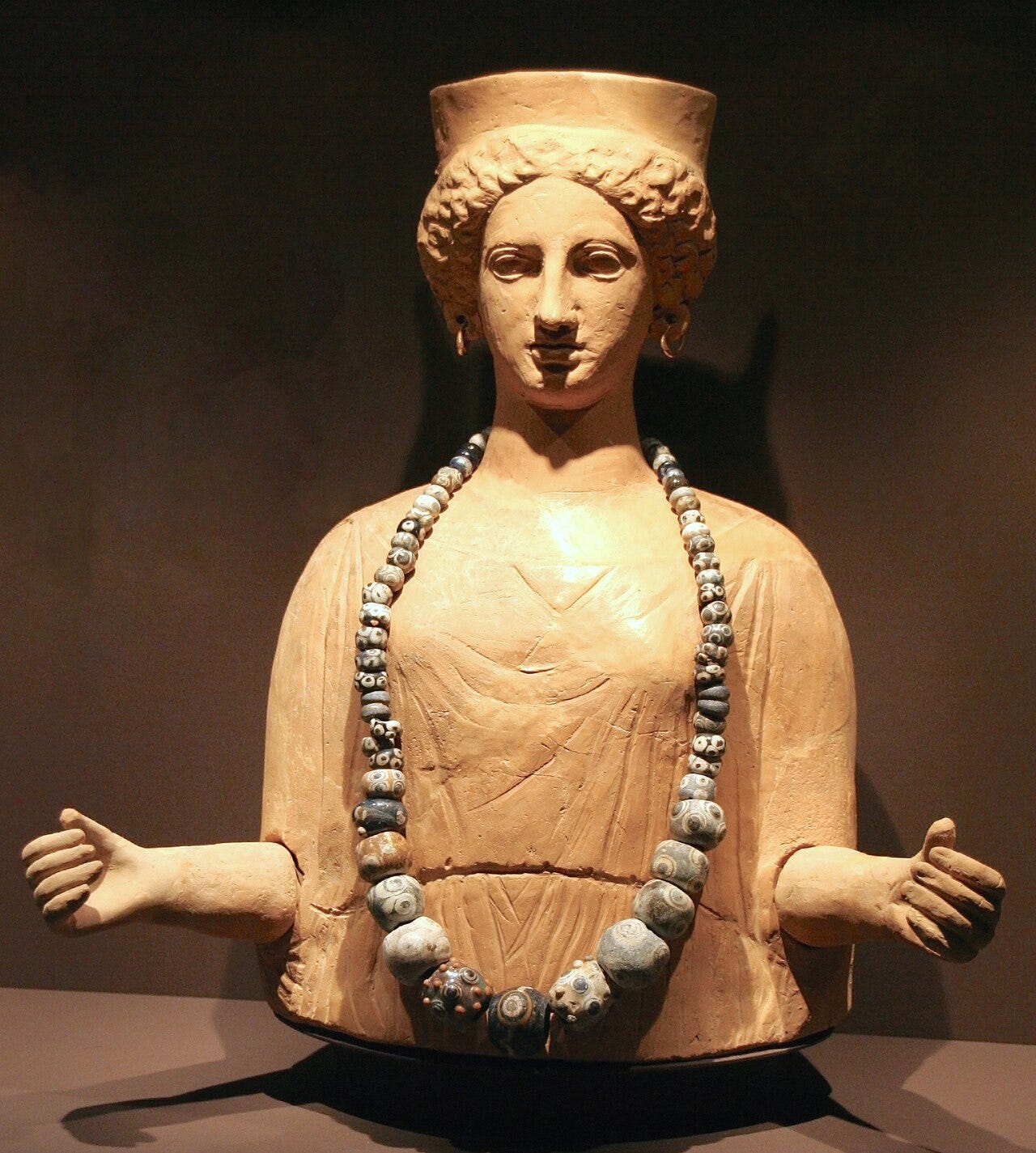
Adorned statue of the Punic goddess Tanit, 5th–3rd centuries BCE
What struck me most was how the historical setting never feels decorative.
Rome here is not presented as civilization, nor Carthage as tragedy. What emerges instead is the psychological mutation produced by endless war itself. A people transformed by survival into something harder, colder, almost unable to return to ordinary human time.
“The old rules of war no longer applied. There were none.” stayed with me long after reading.
And beneath the military machinery, there is something even darker moving through the text: memory, ritual, sacrifice, hunger, vision. The sense that violence does not only destroy bodies, but alters the spiritual structure of those who survive it.
This felt less like historical fiction and more like standing inside the consciousness of a civilization becoming irreversible.
What a stunning chapter. I'd happily read your book, in a heartbeat actually.