The Toast
A taste of envy

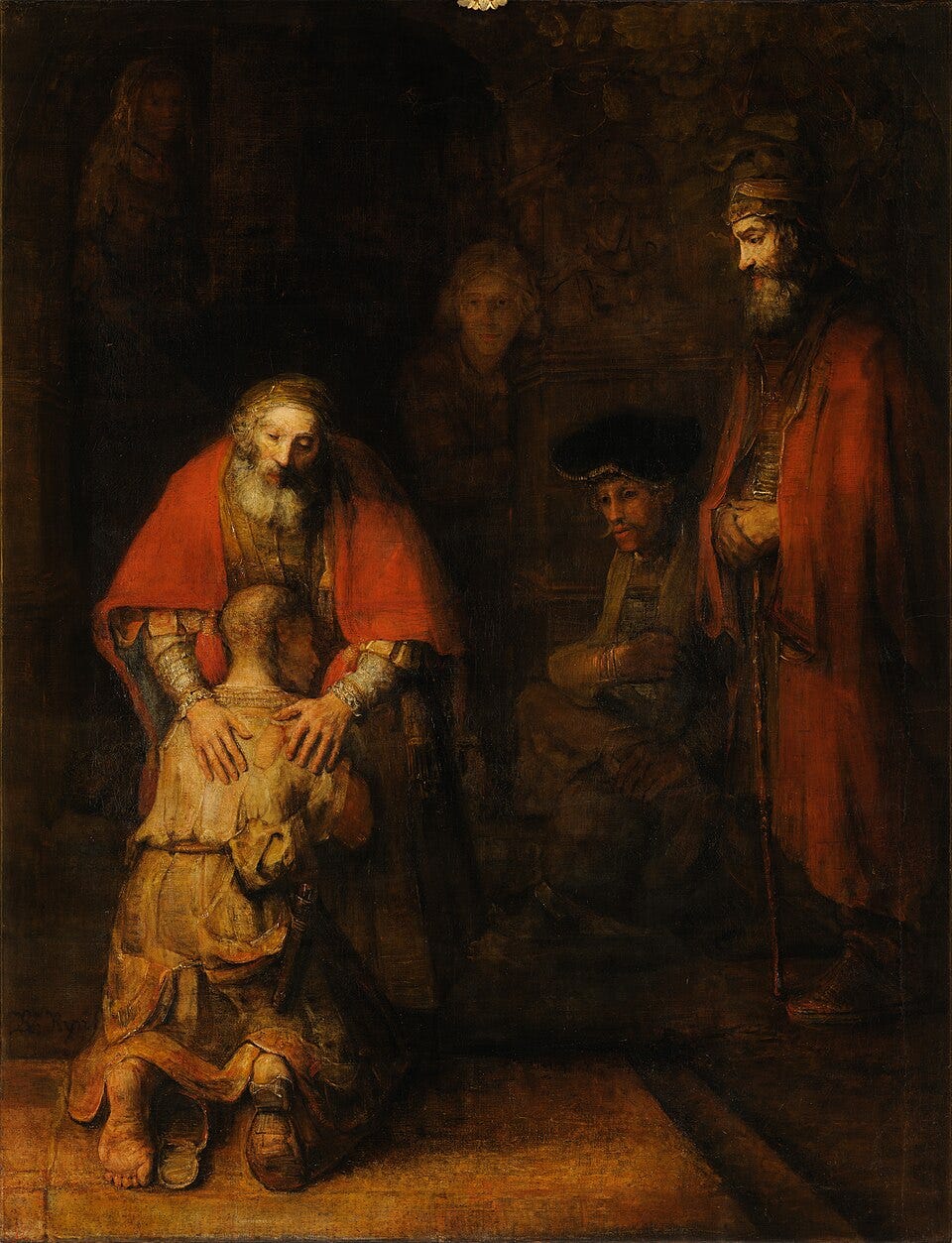
Rembrandt Harmensz van Rijn - Return of the Prodigal Son - 1668
Author’s Note: Written in collaboration with imi (link below) on the sin of Envy.
This piece reimagines the biblical parable of the Prodigal Son through the lens of Robert Browning’s My Last Duchess, with a nod to Poe and some extracts of Milton’s Paradise Lost and a little bit of Robert Frost and Shakespeare’s Iago. Because I am entirely dated and referenced as a poet.
I’d love to know what you think.
The Toast
An invite cataclysms through my letterbox,
falls onto the ochre-red, silken threads
of my imported Persian carpet.
It carries the weight of something important.
Envelope china-white, handwritten and addressed:
“To my dearest Lou.”
The ink, the detonation of a fountain tip,
smudged by a sprawling hand;
his dexter; mine, sinister,
in verdigris green italics.
Upon it is listed a Mayfair address
which I know to be expensive.
I must say I am impressed;
he has moved fast, my brother.
Once a connoisseur of white lines,
a collector of artisan prostitutes,
a fine investor indeed
of our family’s dwindling inheritance.
Now no doubt, in a sleek Savile Row suit.
I can imagine him: tanned hand held out,
welcoming his hungry guests.
A little golden crucifix around his neck.
God bless, if he’s able.
I arrive at the fall of a sultry London evening
and join the glittering procession, into the reception.
Champagne and Scotch are borne
in crystal and anointed on silver trays.
Red-raw slices of roast beef, silver calf fat dripping
off serrated steel serving knives.
A congregation of waiters waiting on our sins.
I see his lover’s predatory nails,
shellacked, emerald and bejewelled.
Ruby-pursed lips, her cinder eyes
sumptuous with contempt.
I realise, I knew her!
Now here she is,
wrapped around my brother,
luxuriating in my family’s wealth.
They look happy. Well, we shall see.
Father greets me, squeezes my shoulder.
“Son, please forgive him for the sin of greed.”
I speak: “I have been here since he left.
And he almost lost us everything!
Striving through nights and days,
I helped you build it back.
That whole bitter year I barely saw
my wife or daughter, save to wake them
or watch them dream. Now you embrace him?
You cast me aside so easily?”
“Because I love him,” Father says,
“And I love you too. You are brothers.”
So what, then, is a beloved to do?
I thought of a schoolroom lesson.
My teacher stands
in her white chemistry coat.
The weight of a thing,
she taught,
is not its mass alone.
There is density too:
so then how much matter can be
accumulated into the space of a single heart?
How shall we assay hate?
How shall we calculate
the gravity of envy?
How fast is the dark?
Having studied, I shall play my part.
“Of course, Father. Take a seat.
I’ll take mine soon. I need to eat.”
I think it is often reported that people
are seldom murdered by strangers.
At last for supper, we are arranged
along a long varnished table,
polished glass dark like a window at dusk,
we can see ourselves in it.
Seated, we begin to eat our meat
as the servers slice it, piece by piece.
I can only observe my brother
and his lover at the head of us all,
smiling with such casual beauty
it makes my life ugly.
I begin to think of shrieking bombs striking roofs,
of plaster boards and walls collapsing inward,
of teeth in mouths shattering like boiled sweets,
of this accursed house entirely disassembled.
Our ashes thrown into the air like confetti.
Shall I sprinkle crushed glass into the hors d’oeuvres,
or else splash cyanide into the Moët?
At that prophetic moment,
my brother Adam stands. He drowns in his aperitif
and clears his throat.
“I have an announcement. Eva and I,
we are engaged.”
My smile, an accelerating wound
that all laughter expands exponentially.
The room nauseates and begins to clap.
I think of my empty bed, the shadows that I now possess,
cold creased sheets that keep me company.
I ponder how I did not want her,
not then. But now, so much more
than I ever had before.
Perhaps as great as my hate for him.
They have sublimed into the same thing.
Envy then, it must be the original,
the Genesis of every other sin.
The perfect love before the fall,
sundered when the divine’s gaze
fell and split upon a mortal.
Why choose ice then,
when we can choose fire?
Why know love,
when we can know desire?
I stand up, cut glass in my hand.
We bear the light, so precisely,
on our silver rim.
The room looks to me
as an orchestra to its conductor.
But oh, I have such plans for them.
Such plans, even the devil cannot conceive,
for angels dreamt of envy.
They shall all be buried
beneath the rubble.
“A toast then to the happy couple!”

Thank you to PancakeSushi, Gary L Taylor Sara da Encarnação A Writer’s Voice and Laura B imi for collaborating!
This left me with a genuinely uncomfortable feeling — and I think that is precisely its strength. Envy here never feels abstract or merely declared; you feel it growing, almost justifying itself, until love, resentment, and desire become impossible to separate. And that final toast… after being inside his mind, it feels almost more unsettling than an explicit threat. Powerful work.
Iago; imago.