Janus
Ainon arrives at Utica, recounts his time with the legion in Sardinia. The temple fire and what still remains.

Content warning: This chapter follows a first person POV Roman recount of conquest in the ancient world. It contains depictions of violence and war.
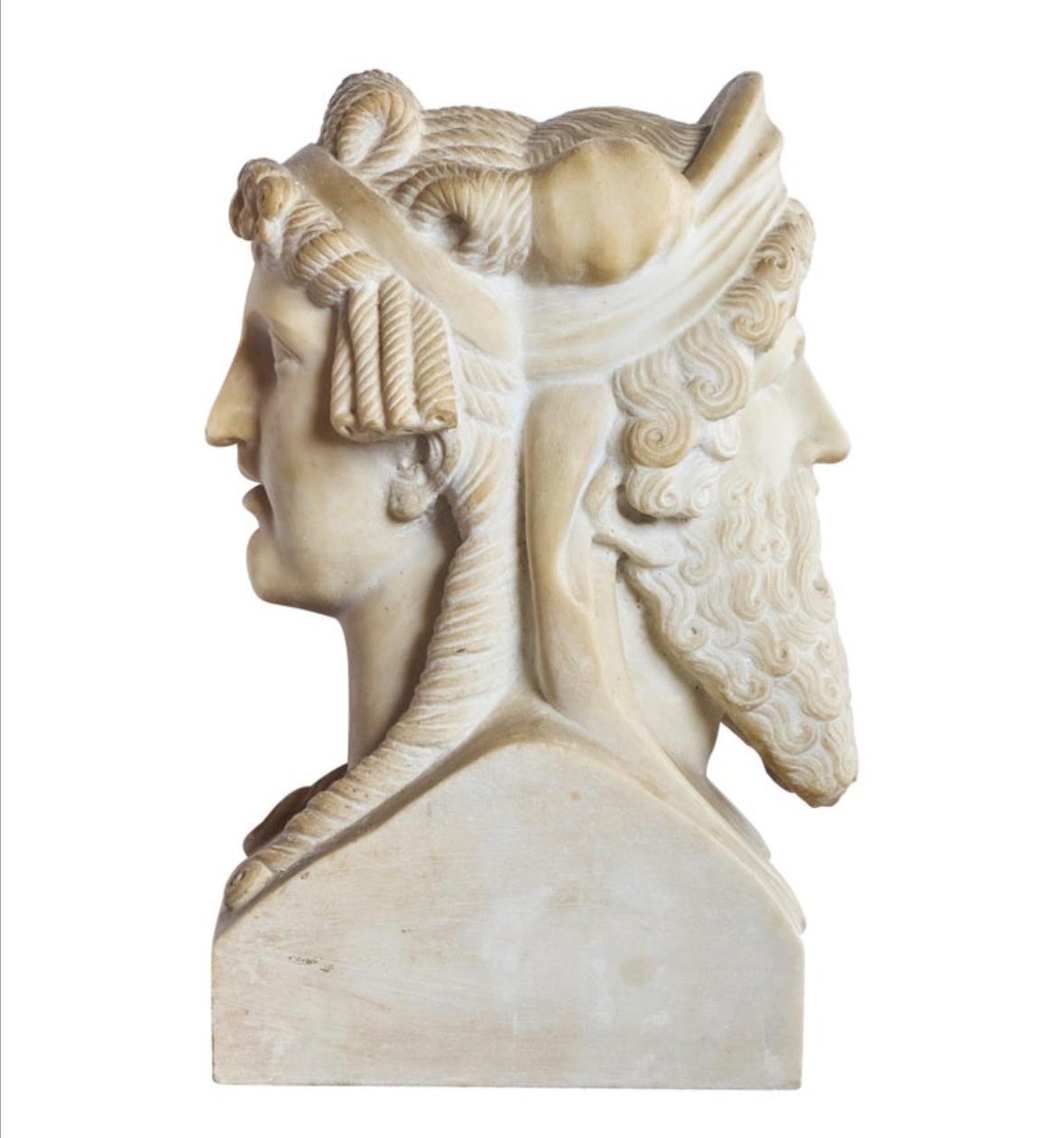
(Double Janus - Unknown)
I stand on the scorching sands of Utica, our enemy’s bustling trading port perched on the tip of Tunisia. The air is thick with the mingling scents of sea salt, dried fish, and something sweet like overripe fruit, rotting in the sun. I know the smell.
The hour is early, death has arrived.
Down by the docks, the traders have scattered, their hands clutching whatever they can carry. Their eyes flick to the red banners of Rome and the fleet of our galleys that roll in like a shifting wall of timber and bronze, sails swollen with the breath of war. Our might is without equal.
Utica overlooks a sweeping bay and a sheltered harbor whose waters, calm today, shine sapphire under the sun. Sea birds fill the sky, we must find their nests, fresh eggs are a welcome addition to the stew each night.
Sometimes you find a chick in them, the crunch puts iron in your bones.
We sent scouts ahead to warn the city’s merchants to vacate the docks, leaving them to our fleet, over five hundred galleys and other ships, enough to blot out the horizon. Her people remained, foolish, many now clog her streets dead. What did they expect?
I sigh. Such tedious work it will be, moving their bodies. I have often thought that we have found a use for almost every dead creature. Leather from hide, fertiliser from bone, meat from flesh. Man is a worthless thing, only in slavery is he a commodity. He consumes when he is alive, and when he is dead, his body rots and smells of open sewers. Spreads infection. We will clear the streets, we will burn the dead in pits beyond the city limits. We will not remember their names. No stone will stand to mark their fallen, they have fallen out of history.
I stand at the docks. To watch the sea is to read a history of Rome.
To the east of Utica, across the Mediterranean, lie Masala and western Sicily: volcanic rock, cypress trees, jagged shorelines. Monuments to countless dead Greeks, Romans, and Carthaginians mark those lands, where our peoples have warred for centuries. Now, all of it stands firmly under our aegis.
Turning my gaze north, I see Sardinia, a land of opal seas and white sands, dappled by the shade of juniper and olive groves. Beyond the coastline rises a dense mountainous interior where wanderers vanish without a trace, perhaps claimed by hungry gods, or by men hungrier still. Or maybe they found paradise and chose never to return. All anyone ever finds are broken sandals and bones. I stand on a long jetty beside our ship, which we named Triton, son of Poseidon, to honour the Lord of oceans before our passing over his domains. I look out across the water and swear I can see the faint outline of Sardinia’s southern beaches, swirling in the shimmering haze of heat rolling off the ocean. It must be an illusion, the island is easily a hundred leagues away, beyond the reach of mortal eyes. Janus, the god of thresholds, watches over memory, his faces turned both forward and back. Our memories stand before us as well as behind, impossibly close in the instant they appear, yet forever out of reach.
I remember those forests. The rivers, the bones. For a year, we marched those cracked and dusty paths, our sandals sinking into winter’s mud and burning against summer’s heat.
Two local tribes had revolted against our rule, perhaps swayed by greedy men lusting for power. Perhaps Carthaginians or Greeks whispered in their ears. Perhaps they promised allies, kingdoms, and glories. Lies. They were the Illienes and the Balares. I’d never heard of them before. No one ever heard of them again.
Their struggles hadn’t concerned me back on my mother’s farm in southern Italy. Yet I knew they had to be destroyed. If Rome commanded it, her legions obeyed. That was the simple axiom that had kept barbarians from our gates for two centuries since the battle of Allia, when Rome was last threatened. We never asked why, only what needed to be done. We never asked how, only when.
Woe to the Illienes and Balares.
For months, we chased rumors and abandoned campsites through rocky outcrops and unploughed fields, they would always slip away. Every time we thought we’d outmaneuvered their armies or caught them in a trap, they slipped through like smoke rings unraveling in air. They knew the country, the seasons, the hidden paths. At night, they came like whispers, blades slipping through canvas and flesh alike as we slept. The night watch muttered of eyes in the treeline, silent, searching, probing for weakness. When they came, it was with the speed of darkness swallowing a room as the last torch guttered out. Wearing no armour, their bare feet left no trace as they stalked through the long grasses, unseen, like wild cats on the hunt. At dawn, they hurled javelins from concealed ridges as we marched, cutting down two or three of our number before vanishing, leaving behind only cooling corpses, stiffening as the wind sighed through the pines that cloaked the hillsides surrounding us. Their aim was to sow fear and uncertainty, to reap disunity and chaos. They fought as the Carthaginians had in Sicily, war by ambush and shadow, an island cut off from resupply, where our numbers and formations meant nothing. And they were winning.
By the fourth month of the campaign, we still hadn’t fought a single fixed battle, yet over seven hundred of us lay dead.
I remember the silence of those evenings when we burned them, cremating their bodies on pyres of oak along with their armor and weapons. We would stand for hours, watching our comrades render down into glowing embers. At day break, a dim sun slowly rose over the blackened earth. "And there goes Decimus, honored friend. Now ash on a foreign isle, blowing on the cold air through unfamiliar groves," I recited, my voice barely audible over the crackle of fires dying down. Familiar now. Summer was turning to autumn, and we had accomplished nothing we’d come to Sardinia to do.
We were fighting phantoms and swirling winds. Tiberius Sempronius Gracchus, our general, whose Gracchi forebears had originally conquered Sardinia, had grown tired of these games. He was the son of a glorious dynasty that had once enjoyed triumphs for subjugating Sardinia, and he would not return to the Senate empty handed, disgracing his family’s bloodline.
I saw him pacing outside his tent at night. He never slept, only watching the embers and dreaming. Of what, we cannot know. On a chill morning as the year ended, he called us all together. With cold command, he laid out his plan, made real those dreams.
He sent out orders that every town without walls be burned, every cultivated field uprooted and made barren. Every farmstead and village liquidated. We would poison the wells, dam the rivers, scour the land of anything to eat or drink. We would starve the citizens, until they killed their last mule for meat, until their children died in their arms, until they could no longer lift themselves from their beds, until the dead lay in the streets untended and without burial rites, until brothers killed each other over a loaf of bread. Then we would see if the people still kept the rebels’ secrets and holdouts safe, if they would fear us more than they loved them.
Gracchus was right. Within a few months, we had found many of their hiding places and flushed them out. If they pleaded for mercy and surrendered to us, we crucified them high up on the steep rocky hillsides so their fellow traitors would see.
You could see the silhouette of hundreds of crucifixes set against the wide and low winter sun as it set behind the jagged ridgelines and bluffs of Sardinia. Bristling like a thicket of thorns. Sardinia itself had changed. The land bore our mark now, etched in flame, in hunger, in the long shadows of our crosses.
If we did not have the time or materials to set up scaffolds, we would tie their hands and throw them from the cliff tops to be sundered on white rocks and the churning Tyrrhenian Sea. I remember a man from my Contubernium numbering eight other fighting men, who called himself Tarquin. He was the ninth in our number, which was an ill omen as when two of our groups joined together to form a larger one, there were seventeen of us assembled. VIXI. "I have lived." The number of death.
We assumed his name was a jest. He claimed his mother had named him so all good men would fear him. One night, he told us how his father beat his mother so savagely with a broken amphora that she never spoke again. She only stared, mute as Cassandra, full of prophecy, knowing what would come the next day and the day after that. Tarquin, only fourteen, offered his father a cup or two of wine imbued with valerian roots from the apothecary. Once the man was loose, he leaned into his father’s face and leered, spitting the words: "Sic semper tyrannis," before crushing his windpipe with two pincered fingers, locking their gazes as life ebbed away. His hands were as still as the Sphinx, waters after storms.
His mother stepped into the room and beheld what her son had done. She recoiled and wept. Her tears were not for her husband. Only then did he let go of his father’s throat. Looking up, he turned to her: “Mother,” he said, licking his lips. “What’s for dinner?”
He used to tell that story to anyone who met him. He would watch them as he spoke, searching for a flicker of disgust, a grimace of unease, testing them. He added more details to the tale over time, finessing each retelling. I was never convinced it happened. Or perhaps it had happened, but not to him. Perhaps he had borne witness and decided to adopt it, like a lost child, an orphaned origin. That it had grown with him, wearing his name as he wore its shadow. Or perhaps it was neither true nor false.
"I looked deep into his eyes, Ainon," he said to me one night over the campfire, his face lit upwards by the flames like an ancestor’s plaster death mask. "There was no end to the deep."
He claimed his people were originally from Gaul. He was tall and pale enough to make it believable. His skin looked like fresh milk left just long enough in the sun for the top to congeal into a whitish yellow where the fat creased and thickened. As we browned like berries in the sun during marches, his skin never changed.
He towered over us, a head and a half taller, his frame as broad as an ox’s. Silver ringlets of thick, blonde hair framed his bone-white face. But his eyes, those I’ll never forget, were red. You could see them in the night, a vividness to them like a fox or a cat’s. Predatory and searching. Not the bloodshot whites of a drunkard, but a vivid crimson circling the bottomless wells of his pupils. He had no eyebrows or beard, he smelt of blood and wine.
One of the older men said they found him in a heap of corpses after the battle at Zama. They dug him out fearing the worst, yet like Achilles, he was unharmed. “Praise be to Mars,” the warriors chanted, but he said nothing, only stared at the dead and remarked that they had many words yet to speak. My friends wondered how old he’d been at Zama. Many years had passed, and yet Tarquin’s eyes never dulled, nor did a single line crease his face. The rest of us grew scars, wrinkles, memories. He stayed constant, like the gods had forgotten him.
He liked to play what he called “a little game”. Whenever we had fresh captives to hurl into the sea, he’d challenge us to see who could fling a man the farthest or make him hit the rocks below the fastest. Who could pitch the most over the cliff in the shortest time, as though it were sport. He’d clap and salute us with glee, thick laughter booming as the captives slammed against the rocks and tumbled among the broken bodies already there.
He’d say “Why do they try to free their hands as they fall? Do they think they have wings?” Then he’d roar with laughter, “Wings!” as though it were all the finest jest in the world, as blood coated the stones below and dripped into the roaring sea.
One day, sick of the senseless killing, I challenged him. My voice felt like a small thing against the roar of the waves as he stood there on the cliff top.
"Enough, Tarquin."
He turned:
"We could sell them. Or take them as our own. This serves no purpose."
My voice felt weak in my throat, my reasoning thin, lost in the sky.
"Reason is for men," he said after a moment, his voice almost gentle. "You think you’re just a man, Ainon. But men don’t carry shadows like yours. I’ve seen it before. At Trebia. At Zama. And now, in you."
His gaze lingered on me.
"You’ll see it soon enough. Your purpose follows you without rest."
His huge palm settled over my chest, immovable, like the final stone sealing a yawning tomb. He laughed, his laughter had teeth.
The moment his fingers touched my skin, I felt it, that pull.
I closed my eyes, and there it was.
A dark star.
He inhaled deeply, and as he exhaled, it was as though he stole every breath I’d ever taken, dragged from the hollow of my lungs and carried away with him.
I fell, as though the ground had vanished beneath my feet. My legs buckled, my body weightless, frame unreal. I couldn’t feel anything, couldn’t breathe. My chest clenched, muscles around my ribs locking like a vice. I clawed at the air, at nothing. I was drowning on dry land. My mouth gaped open, desperate for breath, but there was none left to take.
I lay there, paralysed, the sky above me, warping like iron dropped in a forge. I looked down to the rocks below, where the tide shifted corpses, limbs tangled like driftwood, mouths open in silent screams.
That’s when I felt it.
A stirring beneath my ribs, faint at first, like holding your breath too long, the urge overwhelming your will. Then it grew stronger, moving against bone and flesh. Something cold, coiled, and unfamiliar. A quickening. A second heartbeat.
Tarquin stated, as plain as day: “History does not punish men like us. It sings for us, we sing for it. I have walked through ruins before they were ruins. The skies cracked, but no Gods came through. The Gods do not save, they only demand. You would not seek to know the Gods, if you knew them.”
The sun set, and shadows met beneath old and long dead trees, gnarled by salt and wind. I began to wonder if he could ever stop. I never saw him rest. It was as if he were some ceaseless roaming thing that would die if it ever ceased moving. I saw myself in his eyes, changed.
As the shadows crept closer, thinner and darker with each passing minute, I wondered if the gods had marked me long ago. VIXI. I have lived. The dead have no use for names. I have one.
But now, something else lives in me.
I sat cross-legged, watching as the shadows stretched across the stones, waiting. Then we met.
When we discovered the rebels’ final holdfast, a temple with a sacred well perched high on a wide plateau in the rugged, inaccessible centre of the island surrounded by thick thorny forest. We mobilised every man we had and surrounded it. For three weeks, we besieged the stronghold with earthworks and siege engines.
When at last we broke through its walls and splintered its gates, we put every man, woman, and child to the sword. Praise be to Mars.
I remember my first kill in battle was on that day. All the others had been those without blades to fight back.
I was among the quickest to crest the wall with the rest of the Hastati, the youngest and the first into battle. I wore my father’s old helmet and a small battered chest plate slung in a leather harness for protection over a moth-eaten woollen tunic. It was a marvel I was not felled as I advanced to the ladders under the hail of slings and spears. I caught one on my shield and it split down the middle. I cast it aside and kept moving.
On top of the wall, a boy, perhaps my own age, hurled a javelin at me. It narrowly missed and clattered onto the moss-covered stones of their makeshift fortification. I advanced, and he began to run. I caught him from behind and drove my sword into the soft space between neck and shoulder blade. I felt his collarbone resist and crack against the edge of the gladius as I pressed it down with one hand, and he dropped to his knees. Then I set my other hand on the pommel, gripping so hard my knuckles turned white, and forced the blade all the way down and inside of him.
His body went slack, a thin trickle of blood seeping from his mouth before he fell forward. I never saw the colour of his eyes. I knew nothing of his name, his gods, or his family. I pulled out my sword and wiped it on my thigh, leaving a red smear. What little of him remained.
Titus, a legionary with ten years more experience, laughed as he ran by, spear in hand, shouting, “Marcus, I would wait until after our work is done to wipe your blade, boy. Mars abhors a clean blade, and the blood will lubricate it. This is thirsty work!”
I glanced down at the Sardinian boy’s bleeding body, thinking, How easily men die... before rushing to catch up.
In the confusion, I stepped away from the temple courtyard, the torchlight flickering on shattered columns. This place stood in a natural clearing of the forest, it looked as if it had always been here. I saw a body sprawled on the clearing’s edge, its throat torn open, flesh hanging in confetti. The marks were by teeth, as though something had clamped down and ripped the life from him.
Beyond him, another corpse lay face down, one hand stretched toward the underbrush, as if he had tried to crawl into the dark. There were no wolves in these lands, they had starved long ago. Yet here was their work.
Ahead, something glinted wetly in the moonlight, a trail of blood leading into the forest. I followed.
The path narrowed as the trees swallowed me. Here, the air shifted, thick and damp, clinging to my skin. I could no longer hear the roar of the assault. Different sounds now: birds calling out from branches high above me, the rustle of leaves, the creak of ancient trunks. I stepped over another body, its face downturned, mouth pressed into the black soil. Another. Then another. They were running, not toward the temple, but away from it.
I pressed forward, my breathing slow, my pulse quickening. I should have turned back, something pulled me deeper. At last, the trees parted, and I found myself in another small clearing before a moss covered gate, crowned with symbols that had been chiseled away centuries ago. Beyond it stood a half-rotten wooden door, wedged into the base of a hill. Dead Gods and dead men. The birdsong had stopped. I felt as if I was being watched.
A gust of wind, sultry and wet like summer rains rushed up from below. I stepped inside.
The tunnel sloped downward, the stone walls slick beneath my fingers. The air hummed, a low vibration, crawling across my skin like the legs of a hundred centipedes, the way it does before a storm.
I emerged into a low ceilinged shrine. There was writing in red ochre on the roof, but I could not read it. The script was made up of symbols drawn in jagged lines, like you’d find on the old graves outside Baiae near Naples. A language for a people who no longer existed, one that would never be read again.
Torches blazed in rusted brackets, the flames throwing shadows. Someone had been here before me. An altar stood at the room’s center, and upon it, an old bearded man’s severed head rested, the firelight behind it stretching its shape against the back wall, a form freed of flesh. Flies everywhere.
A figure stood before it, staring at the shadow as if waiting for it to speak.
“Tarquin?”
He turned, the flames catching his pale, blood-smeared face. He was naked, smeared in mud from the forest and blood from the men.. A woman, a priestess, knelt beside him, her eyes wide, frozen in horror. She did not move, did not cry out. Only from the rise of her shoulders could I see that she still breathed.
Tarquin’s voice rose as a wave swelled in an empty cove, the echo of water on rock: “They built this place in Apollo’s name. But before him… before the Olympians arrived, they worshiped something else.” His eyes, a rising fire under deep waves.
“You’ve seen it, haven’t you?” he asked. “A blur between the trees? Chasing the periphery. The hunter with a stag’s head. The shadow of the thing you would call a god. They had the wisdom not to.”
“Can you not feel that this is the real? That the ritual made you; you did not make it.”
“They are coming,”
A tremor, then the contortion of a smile.
“Brothers”
He ran a blood-smeared hand through the torchlight, and the dancing shapes on the wall flickered in response, yet no true source cast them. “In another tale, illusions always need a form behind them, men are like prisoners in a cave who mistake shadows for truth. But here…” He gestured at the writhing darkness, free of any anchor. “The shadows have severed their chains. They need no object. Freed from form, they have become real. Who can say which is which?”
The flames flickered blue, their light bending as though drawn toward something.
Tarquin inhaled. His breath rippled outward like a stone cast into still water.
He turned to the priestess, reaching for her gently, his bloodstained hands holding hers as if cradling a newborn’s.
“The slaughter in the Temple has opened such a wound. I must act as a midwife, to deliver them into this world. They will remember this fire, Ainon. Fire is always remembered. It is always the end, always the beginning.”
I opened my mouth, no words came.
“You will bolt the door behind me,” he said, glancing at me once more. “And you will say nothing.”
He guided the priestess deeper into the shrine, toward a passage burrowing beneath the main temple.
I watched them go. I did as I was told. Before leaving, I took one last look back into the cave and saw dozens of shadows dancing dreamlike without sleep, more real than anything I’d ever see again.
I emerged from the passage. The forest closed behind me like a wound, the air frigid against my sweat-slicked skin. I had stepped inside only moments ago, yet now the woods lay draped in darkness. Night had fallen. As if many hours had passed above the earth, while below, only moments slipped by. As if I had crossed into the space the dead pass through, where the world collapses to a single breath, and every memory floods back at once, like the ferryman.
When I finally returned to the temple, its gates were still resisting the weight of Gracchus’s forces, the sound of bronze and iron groaning under the battering ram. The remaining rebels, priests and families, had locked themselves inside.
Gracchus, impatient with their resistance, bellowed: “Seal the doors with chains! Lay pyres all around, and we shall burn this place to the ground. Let the Gods see our fire, let the whole world see what becomes of those who stand against Rome. We shall drink wine and feast as it burns!”
The legion, full of hatred after many months of war screams cries of: “Ave, Ave!”
I watched as the flames licked up the columns, old frescoes curling and blackening, until the temple’s roof gave way in a thunderous collapse. The light flared bright, washing out the stars and swallowing the night in a tide of fire. The legionaries still cried, “Ave! Ave!” The roar of the heat struck my face from one hundred feet away. As I stared into the fire, something in it stared back.
By the time the embers settled, nothing remained. I thought of Tarquin and the priestess. No one could have survived such an inferno. And if, by some sorcery, he had, he would be buried deep in Sardinian soil, lost among those who sought refuge beneath the temple, never to see daylight again, entombed with those shadows, and whatever else lay waiting in the dark. A voice in me wondered: would the earth be enough to hold him? Or would it, like a womb, bear him for a time, only to birth him anew.
When the flames finally died, Gracchus ordered the men to erect a trophy, a Tropaeum, so our enemies would remember our victory. It resembled a crucifix, dressed in the arms and armour of the defeated. But we found no intact armour, only scorched cloth, shattered walking sticks, a smashed infant’s crib. Remnants of garments meant for the old and the young. And so our Tropaeum hung with the clothes of babies and mothers. Somehow it was more fearsome for that.
Gracchus was not finished. For the next two months in Sardinia were no longer a military campaign; they became an operation to leave a permanent scar on the memory of its people. It would sit obstinate and hard on their breasts, ensuring that with every embrace, every gesture, they would feel that terrible wound beneath. They would do well to remember it.
Our chronicles later called it The Slaughter and Flight of the Sardinians. So many were taken as slaves that the price of human chattel plummeted across the republic. The slave markets from Rhodes to Italia were flooded.
Slavers coined the phrase Sardi venales - “Cheap as Sardinians.”
The price of a Sardinian child in the markets of Rome was less than a sack of grain.
This is brutal. But brutally well written too.
Impressive.
I could feel that subtle shift, where violence slowly starts to feel normal.Tarquin didn’t feel like just a man, more like something older, moving through the cracks of war.What is he, I wonder?The ending kind of stayed with me, a little heavy. Like ash after a fire.