Dāgh
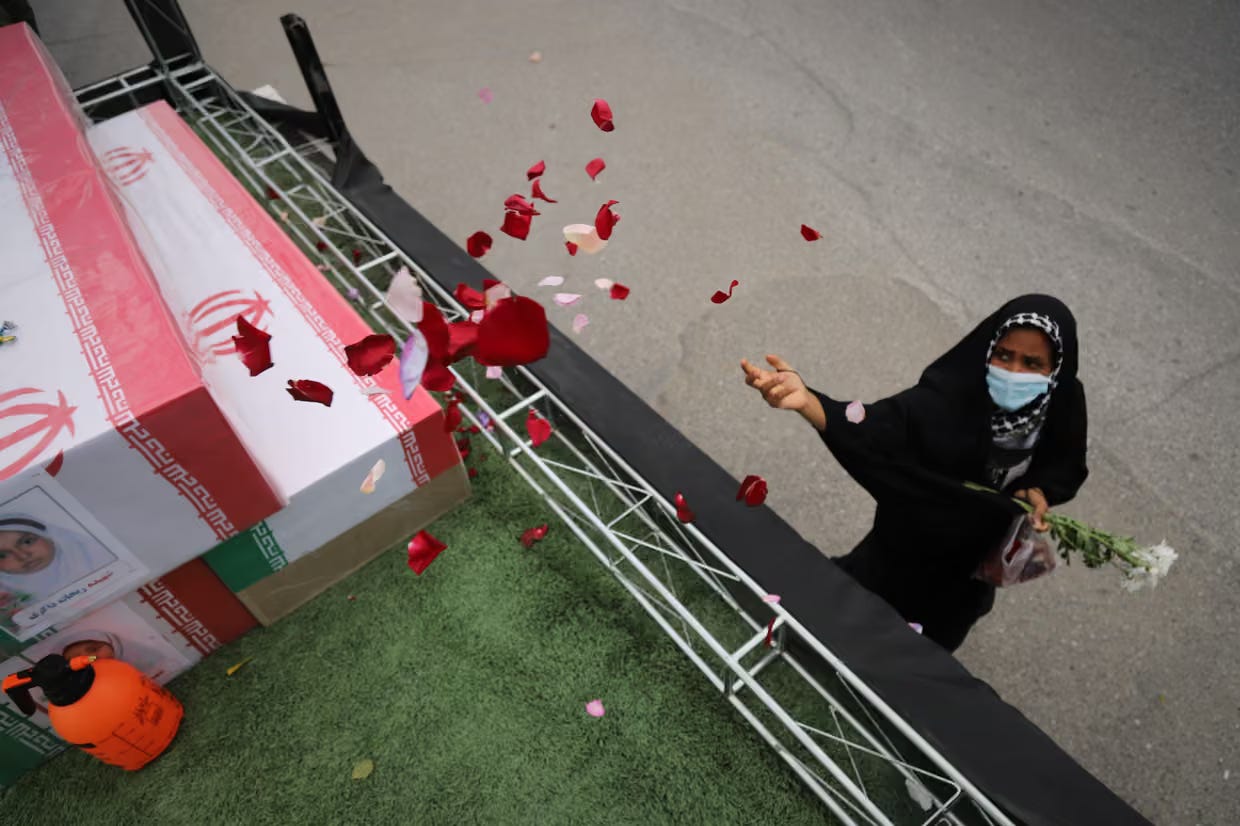
A lament for the bombing of the Shajareh Tayyebeh girls' elementary school in Minab

Author’s Note
Thank you to T.S. Morgan and Cryn Johannsen for helping me edit this. Thank you to A Writer’s Voice for giving me the idea.
This is a lament for the bombing of the Shajareh Tayyebeh girls’ elementary school in Iran. Where over 160 girls were killed by what was likely a US missile strike.
I am no supporter of the Iranian reigime, that has murdered thousands of its own citizens who demonstrated for freedom.
I do feel for the people of Iran who sit between a murderous reigme and the most lethal military machine ever assembled by mankind.
And I wonder if any of this is for them. I do not feel that it is.
Dāgh (داغ), is an Urdu and Persian word, referring to a stain, brand or mark. It is used in Persian poetry (by Rumi and others). I feel it has no exact English comparison. It felt right for the name. Persian poetry is one of the richest poetic traditions in the world, and if you have not read Rumi, I would encourage you to do so.
Dāgh
The Minab flows into the Strait of Hormuz,
mountain water migrating into the Persian Gulf.
There his house sits, set down by his father’s father.
His ancestors built a school beside reed and river.
His family watched white egrets rise each morning
from tangled branches blooming along her waters.
In the evening her ripples purple in the setting sun.
And the Minab flows into the Strait of Hormuz.
His sons once stood as one, but fell apart.
One in Iraq, one in Israel, shot through the heart.
Brothers against brothers in Kurdistan,
and against more of their own blood in Iran.
His wife Maryam died the evening his last daughter died.
Leila.
That dusk descended beyond darkness.
Afterwards the house was quiet.
And the Minab flows into the Strait of Hormuz.
Fasting that morning, he woke to crying.
The streets full before the call to prayer,
his old hands brittle on a worn cedar stick.
The school was burning, black smoke rising.
Parents stumbling blind in dust and ashes.
There are girls inside. There are girls inside.
One small hand struck the window once.
Her little voice inside the fire, then none.
The bombs fall straight this time of year.
And the Minab flows into the Strait of Hormuz.
The roof was ravaged, dark flames rising,
the scene was all smoke and frantic eyes and
screaming parents forced their way inside.
Someone pulled him back by his shoulders.
Habeeb. They are all dead. They are all dead.
He knew by the sound, then by silence,
what he’d been taught all his life then.
And the Minab flows into the Strait of Hormuz.
State news arrived, cameras aimed towards him.
“The Americans did this,” it is reported.
Habeeb asked where their cameras were
when his daughter was beaten for a skirt,
her friend imprisoned, lost, executed.
Where were they when blood ran like an abattoir
across cellar floors and sixteen thousand breathed no more?
The edges of the reporter’s smile pointed upward,
Where were they?
The sky was so blue, it was almost empty.
And the Minab flows into the Strait of Hormuz.
A black triangle, shadow spun, eclipsed the sun.
Fire and death greedily poured down then,
as if freedom were to feast upon them,
and peace would be pulled from the pieces.
Someone cursed the Americans.
Someone cursed the Government.
Innocent or guilty, it was judgement
all fell to their knees, violence inherited the earth.
Smoke as a shroud, drifted down the river.
Heaven stood still, until shrieks shattered silence.
And the Minab flows into the Strait of Hormuz.
Habeeb turned toward the burning school.
Felt the naked heat upon his cheek,
and the fire whispered in the wind:
Neither of them care for you.
They care only for me,
my sleek silhouette slicing the sky.
It is I that burns and will not die.
I will rise tomorrow from the horizon.
This was never for the people,
never for the children, only for the fire.
I will care for you. I will endure.
And the Minab flows into the Strait of Hormuz.
Habeeb thought, were the girls’ deaths easier,
because they did not know their saviours
as they crushed them from above?
How we wish the dead had no names.
But the dead have names.
Leila, Maryam. Like a brand. Dāgh.
And the dead are many.
Habeeb wept beside the river,
And the Minab flows into the Strait of Hormuz.
This poem lands very forcefully. You tell it straight, the grief of this and all wars. You acknowledge the political forces that have been used to justify great evil, while pivoting to the deeply personal. It is not a diatribe or manifesto. The grief over the girls slaughter is made personal and rises above the idiocy of states and weapons. And the refrain that the Minab flows into the straits of Hormuz grounds us in what is holy and real, the land, the river, the people. It calls to heaven for justice and peace.
The terror of the aftershock shuts the airways while reading. So I'll simply say: this piece is breathtaking.