Cato's Last Stand
Carthago delenda est

Hellish Views - Harry Evans - you asked for it.
This is something I wrote a while ago. I hope you enjoy it.
Content warning: This is a story from classical history, Cato the Elder’s beliefs are not aligned with modern ethics (or mine). This story contains references to violence and deals with difficult and intense themes.
Author’s Note
Cato the Elder, born in 234 BCE, was a senator of the Roman Republic.
In 218 BCE, when Cato was sixteen, Hannibal did what seemed impossible and led a Carthaginian army across the Alps in winter, including 37 war elephants, as the Second Punic War began.
Hannibal inflicted a string of catastrophic defeats on Rome. At the Battle of Cannae in 216 BCE, tens of thousands of Roman soldiers were killed in a devastating envelopment. Ancient sources describe bodies in armour pressed so tightly together that some remained upright even in death.
In 202 BCE Hannibal was defeated at the Battle of Zama in North Africa by the young and cunning Scipio Africanus. The war ended, but peace between Rome and Carthage was uneasy.
By 150 BCE, Cato was over eighty years old. For years he is said to have ended every single one of his speeches in the Roman Senate with the same demand: Carthago delenda est.
Carthage must be destroyed.
The Third Punic War began in 149 BCE. Cato died that same year.
We do not know how he died. No transcript survives of his final speech in the Senate.
This is where our story begins.
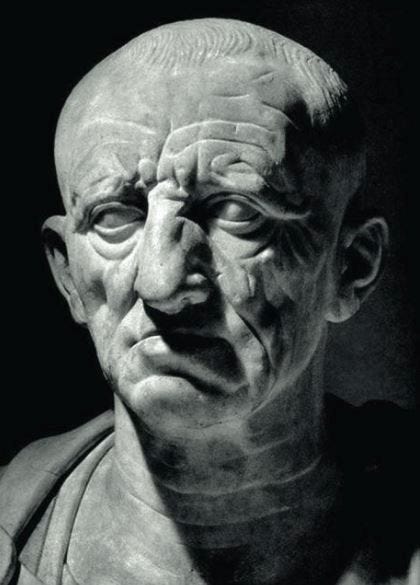
The Patrician Torlonia bust thought to be of Cato the Elder.
Cato’s Last Stand
(December 150 BCE)
Winter binds Rome in weighty iron chains. For the first time in decades, the Tiber has frozen, its ice thick enough for traders to cross on foot, arriving from the Via Aurelia in the west. Patricians and their wives drape themselves in furs or idle in their lavish villas, whilst their shivering slaves scramble through snow-shrouded streets, scavenging scraps of wood to feed their masters’ fires.
They are weak. Decadent. I, Marcus Porcius Cato, know what we become when we forget fear.
What will they do when their gates are battered down? When winter and war sweep through their halls?
They have learned nothing.
I wear only my tattered toga, my chest bared to the biting wind. My skin is lined with white hairs, traced with purple veins. My scalp and cheeks are shaved to coarse stubble. My face is hollowed by age, my brow cracked with lines, yet my brown eyes still fix forward with the same unrelenting intensity they always have. I carry no cane. I will my legs to bear me. My ankles buckle. My sandals slip on the slick marble of the Senate steps. My knees ache and grind as they bend. My thighs tremble. Yet still, I climb.
This morning, I rose early, as is my custom, and descended from the Aventine and the hill I have called home since my consulship, where Licinia and I raised our two sons. Dawn had not yet driven out the night.
My breath misted in clouds before me. I would need to keep moving if I was to stay ahead of the cold.
I passed through the Forum Boarium. The cattle market lies empty now, though the stench of dung and hay still clings stubbornly to the cold stone, and straw still litters the square. In a few hours, it will teem with livestock and traders, a press of bodies, steaming in the cold winter morning.
I crossed the Velabrum, that low, marshy path between the Palatine and Capitoline hills, where floodwaters pool and refuse gathers, both filth and foreign. Even at this early hour, merchants from as far as Jerusalem cry out, hawking dried dates and woven finery beneath moth-bitten canvas. Their long hair and unshaven beards mark their shame.
The seven hills of Rome once rose like columns to uphold a city. Now they serve only as sanctuaries for the rich, retreating from the streets below.
This cannot last. All Romans must stand together or fall apart.
My friend Varius once bet me a jug of wine that he could swim across the Tiber in spring, when the flood was at its zenith, when months of meltwater poured down the valley and doubled its width. He had green eyes and brown hair. We were sixteen, our beards barely grown enough to shave. I told him that to risk one’s life for a jug of wine was not Roman. But still he did.
I never saw him again, lost beneath the swell soon after he dove in, his body a sliver of light, shattered in a thundering torrent of aquamarine.
After days of searching, we found his corpse nestled in a bend of the river, tangled in tall weeds. His skin, slippery green. His eyes were pale white, like fresh milk, souring. Every bone was broken, except his neck. When my friend’s lifted him, it was like watching slaves carrying wet laundry.
I remember discussing this with Lucceius, who could not understand my interest. I kept saying: “If one knows he will drown, why does he still try to lift his head free”
And Lucceius said: “Cato, is that not the state of us all?”
At his funeral, when his mother embraced me, she cursed the gods for their cruelty. Tears streamed from her eyes as she asked me why he had died. I told her he died because Varius was a fool, and that she should not blaspheme the gods.
My father had struck me more than once for crying at a funeral. He said grief was for women, not men. That pain is the tutor of virtue. So, I trained myself not to feel pain.
I must be virtuous, then. I need no teacher. I no longer feel pain. I inflict it. I teach it.
Her fingernails tore at me as if I were his murderer. Her tears and my blood anointed the virgin wool of my toga as I spread his ashes into the Tiber.
As a Roman should.
As I approach the Curia, the Senate House itself, the alleys are choked with smoke from a hundred hearths. The gutters run thick with piss, livestock dung, and olive pulp. Tenements rise crooked above butcher stalls and laundries, stitched together with timber and tar.
I cannot see the Tiber from here, but on hotter days, in the haze and dust of summer, you can smell it. It stinks of offal and pestilence, from carcasses and sewage dumped into it, both animal and man.
The wealthy landowners of Rome burn perfumed incense to hide the stench. But it does not fool men like me.
We do not need to see the marble of a mausoleum to know when something is rotting.
Yesterday, I bade my slaves summon nine widows, wives of the men whose ship was lost only weeks ago to the sea off Carthage’s shore, to stand with me at the Senate steps this morning. I promised payment in silver for their service. The cause of the sinking has not been reported, but I will make it tell a story.
I told the women to wait upon these very steps, draped in black mourning gowns, their faces streaked with ash, their weeping raw and unrestrained, so that every senator passing beneath the arch of our Republic would witness what Carthage has wrought.
They must hear them, their wails threading through the halls, their cries demanding justice, demanding vengeance.
I greet them as I approach the Senate.
Livia. Fifty, her vitality matched by experience. Light as a willow, strong as oak. Her skin dark as wine at midnight, her eyes brighter than a torch newly lit in darkness. She stares at me and demands her coin. I hand it over.
Her husband was a drunk. I think she is glad he is dead. She still wears black, but hides a smile as she counts the silver, hoping they do not meet in Hades.
I pass Fulvia, the wife of Arminius, drowned along with the rest of the sailors. She holds a babe in her arms, but the way she bears him, she could be holding anything, a loaf of bread, a bundle of cloth.
Her skin is pale as lamb’s wool, her hair the colour of amber, freckles marking her face like spilled wine across pale parchment. She says nothing. She does not even lift her hand for payment. I hold her arm for a moment and put the coin into her palm.
I think. Better not to possess gold, but to possess those who hold it. I move forwards.
A Greek philosopher might have comforted her. But I do not. I have not come here to write philosophy. We know this in battle, and in animal husbandry. Bearing the weak slows the strong. Rome will lose her empire when infected by Greek letters.
The other widows I could not find. So, we found prostitutes and actors to take their place. Not knowing the dead men, they wept louder still. They earned their silver. I told them to wail like the Furies, and from their wailing, even the Furies would have fled.
Like Euripides, I have set the stage.
I once walked the streets of Carthage. As an ambassador. I was sent five years ago to arbitrate their dispute with Numidia. I made the journey by ship, two days from Sicily.
I remember watching the chalk-white headland receding behind us, fading into the morning mist. I remember thinking that for almost seventy years I had fought this city, offered it my blood in defiance of generations of hostility, and now, in my dwindling days, I was to see it. For the first time, to meet its people without gladius or shield in hand. Without a speech calling for their deaths.
Beneath the pristine blue waters of this wide-open bay lie buckled bronze rams and shattered shipwrecks. Between them, on the sea’s sandy floor, shift the bones of over one hundred thousand men, killed in the battle that bore the headland’s name, Ecnomus.
I was a child when it happened, but I remember Rome. The celebrations when our victory was announced. The embraces in the street, the music into the night.
So much death. So much time. Am I the only one who still remembers? Time, an ocean so wide it drowns memory.
I looked out at the sun shearing off the whitecaps of the Mediterranean. This is what they would have seen that day. This is what they would have smelt. The touch of smooth cypress wood beneath the hand, just before history collided in splinters, bodies, and wrecks.
We see only the crests of waves, but we are pulled by the undertow. It is hidden. It cannot be seen. Only felt.
So much time has passed, and yet none at all. I am old, but I remember the deaths of my friends, crushed beneath elephants, pierced by spears, drowned in the sea.
The present blurs. It passes like sand through an hourglass. The past seems brighter. Sharper. Its moments stretch and shimmer, held longer in the mind’s eye, crystalline and painted in vivid colours I can no longer use. Only recall.
Back then, when the world was new, every breeze brought a shiver to the skin. Every cut across the flesh felt as it should.
Now I swim in cool waters, but nothing chills me. The wounds of fortune’s blade draw no sensation. The scar is too thick. Feeling, and relating, have become a ritual, the memory reenacted of what hurt, of what one ought to feel.
The present feels like a dream inspired by what I have lived. A memory that does not belong to me. My whole life has been spent shutting the light out. Shrouding the soul.
When I arrived at Carthage, after days on the sea, I entered their great harbour, carved from pale sandstone and shaped into a near-perfect circle. I had seen the vast harbours of Alexandria, Ostia, and Piraeus, but never anything like this. It was immense, large enough to cradle more than a hundred ships, each docked with geometric precision in concentric rings.
The harbour walls were colossal, set on hidden mechanisms, able to swing open and admit vessels to the open sea, like the petals of a mechanical flower opening in the sun, releasing or receiving ships at will. Built to shield ships from storms and waves, to house more vessels than any harbour in the known world, and to let them sail as they pleased, never waiting for the mouth of the port to clear.
What minds conceived of this? What hands shaped it? What knowledge passed from engineer to stonecutter, from compass to quarry, to bring such a wonder into the world, standing on the shores of Africa, staring at Europe?
Its presence made me uneasy. Rome was cluttered streets and wooden buildings, crooked and listing. This place had been made by a people who dreamed in geometry. Its very existence made Rome feel lesser.
As evening set in, I drank their wine, unwatered, laced with foreign spices, sweet and bitter. I sat among their councillors, men from every corner of the earth. Not Carthaginians by birth, but loyal to Carthage alone. Africans. Arabs. Phoenicians. Greeks. Egyptians. Persians. Even Romans.
The city was a haven for the lost and the defeated. She held her arms wide across the sea and welcomed those with nowhere else to go, many whose homes had been destroyed by Rome, and they built, and they thrived. Whilst we watched and did nothing.
The streets were alive with scent and sound, even at a late hour. Incense from Cyrene curled through open-air stalls, where copper bowls hissed with lamb and coriander for hungry travellers.
Traders shouted in half a dozen tongues. Dried dates, salted fish, pickled lemons, saffron, honeycomb, and cinnamon bark changed hands on every corner. There were perfumes thick as oil, made from jasmine and crushed myrrh.
Children ran barefoot through the crowds, their laughter trailing behind them like ribbons. I learned their gods by name. Tanit, blessed lady. Baal, mighty lord.
I met their elders, robed in bright colours, their hair long and perfumed, their beards dyed and oiled like eastern kings. Their skin was of every race imagined. Their women were priests and traders, landowners and doctors. Even their coins were stamped with the image of their ancient queen, Dido. Whore queen. Queen of whores.
In this place, it seemed, it did not matter where you were born, or what you were born, only what you chose to become.
Their streets rang with the sound of gold being counted, wine being poured, life being lived. Their tables were heavy with indulgence. Their women wore what they pleased and walked freely among the men. They bowed to us, but I saw the pride behind their smiles. Even in defeat, they had not learned to fear us.
If they will not learn fear, then they must be taught in some other way.
There is an otherness in Carthage that no treaty can purify. It must be refined in the crucible of war, until nothing remains of its people but ash and flame, remade as Rome.
Or not remade at all.
I continue my climb.
Once, I led armies. I governed cities. I was consul of Rome.
And now?
Now, I struggle to command my own legs to climb these steps. My heart falters, stumbling and weaving like that tired Greek runner at Marathon, arriving triumphant, gasping his message, then falling.
I will not fall before delivering my message. I will climb these stairs. And if death seizes me before I have spoken, I will crawl from Hades to finish my speech. Dead or alive, I will climb these stairs.
Cato does not fall.
I ask myself, why do I will myself to make this climb? Hatred? No. Not hatred. I hate Carthage as a wolf hates a deer. Not out of animosity, but hunger. Something in the blood. Rome needs war as much as its people need bread. Peace does not satiate that hunger, which is why we march.
War brings advancement. A system that rewards conquest, punishes stagnation, elevates the cunning, and crushes the idle. No place for the sons of great men, only for the great sons of men.
As much as we celebrate our victories, we remember our defeats. Allia. Trebia. Cannae. That is why we march. Always away from defeat, always toward victory.
And if you wrong us, we will not merely defeat you. We will erase you.
Until your temples are charnel houses. Until your streets are catacombs. Until your census is nothing but a tally of shallow graves.
And so, I climb.
The Senate House looms overhead, an old lover that has witnessed both my triumphs and failings.
Beyond bronze doors six times a man’s height, a wave of heat rolls over me, thick with smoke that clings to the chamber like a desperate lover. I breathe it in and feel my face again. I rub my hands together, then stop, realising I am not a child. A man is glad for pain. It is a teacher.
I listen.
Servius Sulpicius Galba, Praetor of Hispania, concludes his speech. He boasts of butchering nine thousand Lusitanians as they slept, lured into false peace, then slaughtered like cattle to end their rebellion.
He has grown fat in his praetorship. His lips, bulbous and stained purple from too much wine, curl like a catamite’s or a courtesan’s. Ringlets of perfumed hair fall to his shoulders. His skin is lily-white. His hands are as smooth as the silks he wears.
One look at him, and it is clear how little time he has spent in the field with his legions, and how much enriching himself at Rome’s expense.
The Senate roars in approval.
Then they see me.
The uproar withers into silence. Galba turns, and one by one, so do the rest.
Shadows shift along the painted walls, their colours long choked by centuries of smoke. Flames flicker across the stern-faced statues of old consuls and long-dead heroes.
The silence is so complete, I can hear the rasp of my own breath.
“The Censor!” someone calls.
“Ave, is it I, Cato?” another jests, stirring an uneasy ripple of laughter.
“You have the floor,” says Marcus Balbus, one of the two consuls present in the chamber today. I nod to him.
“How generous of you to leave it so clean,” I quip, and a few men chuckle.
I turn. My gaze settles on Galba.
“I see Galba boasts of slaughtering men in their sleep, cloaked in the ritual of concord. And yet we cheer like children at a circus, blind to the filth we applaud.”
I extend my arm, my finger a spearhead aimed at his chest.
“The legions of Rome were not raised in the fields of Mars to butcher unarmed men like common brigands. We are not thieves in the night. You have stolen more than lives, Galba. You have stolen Rome’s honour. You have disgraced your position.”
The Senate erupts. I have their attention.
Galba’s supporters jeer, spitting curses. His detractors cheer. A third of the chamber sits in silence, watching, waiting. Galba glares at me, his lips pursed in indignation. I meet his stare. Unwavering.
I step into the centre aisle, my gaze flicking toward the altar at the far end, a silent homage. Then I let my eyes sweep across the rows of senators. Many are no older than my grandchildren. They will not agree with me. Not yet.
If I sway the majority, I sway them all. Avalanches begin with a single stone. Once it moves, all are carried along. Once loosed, nothing can halt its descent.
I close my eyes. I pray to Minerva for wisdom, to Mars for strength, to Ira for wrath. Then, I raise my voice.
“Friends, we sit here today, more than fifty years since Hannibal’s armies were smashed at Zama and Roman honour restored. Let us raise a raucous salute to our mighty legions and to the house of Scipio, who honour us with their presence. Praise them for their triumph!”
A rumble of applause sweeps the chamber. Some stand, saluting, fists pounding against their chests. In the far corner, I see the younger members of the Scipio faction watching me carefully. Good. The glacier of my voice can still flow like meltwater when the season and heat of circumstance command it.
“You have grown accustomed to me ending every speech with a call for Carthage to be destroyed. Today, I shall begin with it. Carthage must be destroyed. Do not mistake me for senile, nor brief. I have many dire words yet to say.”
Silence. A cough rattles in the back. The men brace themselves. I see it in their faces. Some are afraid. They know not of what. Let them discover fear.
“You know me, old Cato. I fought in our Second Punic War against our forsworn enemy. My father died fighting Carthaginians in Sicily over eighty years ago. My family has bled for Rome, standing as a bulwark against Carthage. And now, I bring you ill words on an ill wind. Do any of you doubt that Carthage rises anew? My last embassy to their city showed me fortifications stronger than ever, warships swarming their harbours, streets swollen with ranks of Greeks, Libyans, and Phoenicians, all plotting our downfall. They have learned much since Zama. They have studied us. And they have prepared.”
“At the start of this year, they struck against our sworn ally, Numidia, in blatant defiance of the treaty they signed in their defeat. Worse still, when we sent aid, three grain ships from our convoy were cast off course by a storm, driven helpless into Carthage’s harbours. Who among those crews yet lives today?”
Hundreds of eyes fix on me. Hundreds of ears hear only my words. Then, I answer my own question.
“None.”
Silence. Then gasps ripple through the chamber.
“Not one. They gutted our unarmed sailors like beasts, offering them to their gods with blades anointed with Roman blood.
You saw them upon these very steps, the widows of our murdered sailors. Their faces smeared with ash, their grief raw, their cries still echoing through these halls. Good Roman women, their husbands torn from them, sacrificed like oxen in the temples of Carthage’s cursed gods. Their bodies carved open, left to rot, stripped bare and unattended, in foreign lands.
And still we sit here.
Still, we wait.
Shall we grant them time to strike while we slumber? Shall we wait for Carthage to smash our gates while we recline in false security?”
A restless murmur stirs. Some nod, grim-faced. Others frown, weighing my words. Pebbles loosen in the landslide. Soon, the rest must follow.
“We will demand the bodies of our dead. But we will demand more than this. They must burn their fleet. Bury their weapons in the earth. Tear down their walls to rubble. Be driven from the sea to the deserts of the interior. Let them live as herdsmen or farmers, if they live at all.”
A lone senator cries: “Burn them all!”
“If they refuse? Then let it be war. Let it be the last war. The war that ends Carthage, grinding every brick to dust, until even the memory of their city is buried beneath Roman feet.”
A senator to my left pales, his lips parting, a flicker of horror. But his horror is drowned beneath the thunder of fists pounding the benches. The scent of blood is in the air.
Galba rises. His rings clink against the bench as he steadies himself, flushed and scowling.
“Enough,” he says. “Must we bleed Rome again for your obsessions, Cato? Carthage is beaten. They trade in spices and ink, not iron. You speak of walls and fleets, but I see only the fears of an old man.”
A low murmur passes through the chamber. A few nod. Others glance at one another, cautious.
“You would stretch our legions to the edges of the world,” Galba continues, “to salt foreign earth in pursuit of a ghost. For what? Glory? Revenge? A monument to yourself?”
I turn toward him. My gaze settles on his face like a whetstone.
“You fear war, Galba, because you know you would not survive it.”
Laughter breaks from the younger senators. A few jeers. Galba flushes darker.
“This is not statesmanship,” he snarls. “It is vanity. You would drag Rome into ruin to carve your name into the ashes.”
“No,” I say, “I would drag Rome into war so that it still has a name at all.”
A hush follows. Then, a new voice speaks.
It is not loud. It does not need to be.
“Cato is right,” says Scipio Aemilianus. The adopted grandson of Scipio Africanus. Conqueror of Hannibal.
The chamber stills. Even Galba’s mouth closes. All heads turn.
Scipio stands at the edge of the hall, young and imperious, his hand resting on the pommel of his sheathed sword. His voice is calm but carries.
“They broke the treaty. They bled our sailors. They dared to test our patience. If we do not answer now, we will answer later, when their ships return stronger, their walls higher, and our children the ones who pay.”
He pauses.
“Strike first. Or Rome will fall second.”
I salute him. A breathless silence. I move with the momentum that Scipio began.
“When Rome was brought to the brink at Allia, when the Gauls stormed our city and defiled our streets, how did we respond? Did we cower in our beds and wait for death? No. We bared our teeth and fought, old and young alike. We swore that never again would our people suffer such humiliation. Woe to the vanquished.”
A single stone has begun its slide. Inevitable.
“At Caudine Forks, our legions were broken, our men forced to pass beneath the Yoke. What did we do? Our disgraced consuls, freed from their shame, offered their lives to the Samnites, for a general who returns home in dishonour is no general at all. But Rome? Rome rose in fury.
We waged war upon them, took victory after victory, town after town. Who remembers the Samnites now? There is only Rome.”
The energy in the room swells, feeding on itself, rising to a fever pitch, redoubling as it surges.
High above, the mountainside begins to shift, to slide. It has many leagues yet to travel, but will only gather speed now. Its destination lies far below.
“Is it not true that after Cannae, after all our defeats, we rose again? Did we not pay blood for blood? Did we not raise an army unlike any before it, an army that swept across the sea and brought war to Africa? Did we not break them? At Utica, at the Great Plains, and finally, at Zama? There is no defeat, only the exorcism of failure and the pursuit of war.”
A single voice rises, then another. The landslide begins. Applause cascades, roaring, devouring, swallowing itself, an unstoppable collapse of motion and momentum. The chamber quakes beneath it. Senators glance at one another, their excitement mounting. Their resentments, their grudges, now swept into the rush of a force that cannot be halted.
I spot a young senator reclining, fingers idly drumming the armrest, his gaze distant. His toga is trimmed in Tyrian purple, the stain of Carthage.
I level a finger at him.
“Young man, you do not know our history. So I will teach you. Carthage and Rome. Our two cities, our two peoples, have been locked in struggle for a century. With forty years of continuous war. Five generations have endured it. Entire bloodlines erased. Armies of orphans. Fleets of widows. There is no road to peace now. Not while Carthage skulks in the shadows. It must be their total destruction. Or ours.”
I motion to my side.
“We are our great-grandfather, drowned in his armour at Mylae, a spear through his side.”
I thump my chest.
“We are our grandfather, heart crushed beneath his breastplate at Cannae.”
I raise my hand in salute.
A few shift uncomfortably. Some glance at the black-clad widows outside. Good. Let them remember. Let them feel the weight of the dead pressing upon them.
“We are our father, sword raised amid the dust of Zama. And here we stand. Rome will not fall whilst brave men stand.”
The chamber stirs. Then it surges. The first fists slam down, then more. A roar breaks free, rolling, building, unstoppable.
“Men of the senate of Rome, will you stand with me today?”
I wait. I feel the silence. I live in the pause. The space between words. A hundred eyes only on me.
Then I feel the tremor rising. The air shakes. It has arrived. We are swept away.
“Down with Carthage!”
“Carthago delenda est!”
“Blood! Blood for Roman blood!”
I have them. I have them all.
I realise I have called for something no man has dared to before. Or if it has been spoken, it has never been named. A whole people, a nation, to be wiped out. Not for what they do now, but for what their fathers, and their fathers’ fathers, have done. Not just the destruction of their warriors, but the erasure of their cities, their gods, their language, their children.
A war without frontiers. A war without laws. War in its purest form. Not between armies, but against a people.
It fills me with the thick sweetness of golden honey. As if poured into my ear.
It is from our greatest victories that our deepest defeats are born. A sharp, crushing pain spreads beneath my ribs, as though some old wound has torn anew.
I try to speak, one last stone cast to cover Carthage. But the words stick to my tongue, stillborn. The sacral smoke thickens in my throat. Blood pools, copper-bright, on my tongue.
A final surge of cheers. My heartbeat slams. Stutters. My knees buckle. Crack.
I reach for the wooden benches, but my fingers slip. My grip cannot hold me. My face kisses the marred marble one last time.
The roaring Senate wavers. Torches blur into haze. Shadows and faces of men bellow for blood.
I wonder, was this what Hannibal saw at the end? The unrelenting mass of Roman will he had summoned, crashing through history, burying him.
I cannot stop them now. No city. No people. Can weather the coming storm.
But in the firelight, something shifts. A catalyst.
Their faces distort, more monstrous than man. Shadows stretch, twist, swell. Spilling like ink. Depthless. Endless. Devouring the chamber whole. Larger than the men who cast them. Larger than men should be.
At last, they are free. And at last, I see. See what we have become. Logos split from its source, meaning unbound. The word no longer speaks truth. The word becomes truth. I do not speak it, it speaks for me.
But it does not matter.
I have cast the stone. The avalanche has begun. We are not buried by it. We become the avalanche.
I cannot close my eyes. Then shadows. Then darkness.
And the echo of Carthago delenda est.
Always rising.
Rising.
Rising.
A brilliant piece of historical writing. What struck me the most as I was reading this was how relevant it was to what is taking place right now as we speak. Cato’s unrelenting desire to destroy Carthage and hyperbolic rhetoric to slide a stone to start an avalanche reminded me of similar events that are unfolding before us. It’s unbelievable to think that we haven’t learnt much at all from our history.
You really took his point of view. Also, it’s prose.
I thought you said you couldn’t do that.
It looks like you did here.